
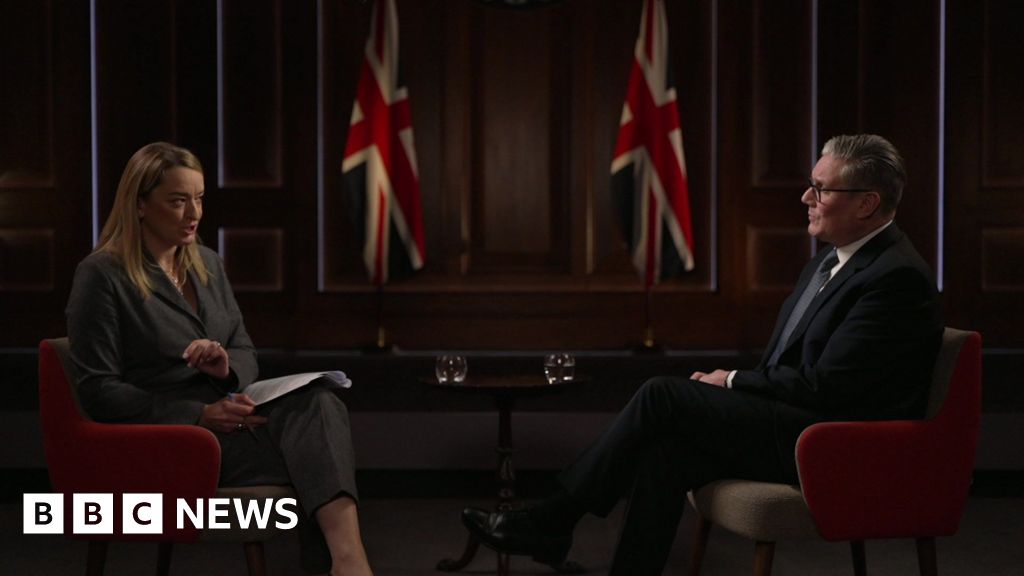
‘I’ll be PM this time next year,’ Starmer tells BBC
The air crackles with anticipation, a familiar hum that precedes significant shifts in the political landscape. When a leader, standing before the nation, articulates a future so definitively – “I’ll be PM this time next year” – it’s more than just a statement of intent. It’s a declaration that invites scrutiny, not merely of the speaker’s confidence, but of the very fabric of predictability in human affairs. It’s a challenge to the future itself, daring it to conform to a whispered ambition. For centuries, humanity has sought to peer beyond the veil of the present, to chart the currents of tomorrow, whether through oracle bones, astrological charts, or economic indicators. Today, in our hyper-connected, data-rich world, that ancient impulse finds its expression in a complex interplay of statistics, psychology, and algorithms, attempting to map the intricate dance of millions of individual wills.
This pronouncement, delivered with the weight of conviction, throws into sharp relief the perennial human quest to forecast and understand the future. How do we, as a society, attempt to quantify such a bold claim? The answer, in the modern age, lies not in augury, but in a sophisticated, if imperfect, ecosystem of social science and data analytics. Political scientists, statisticians, and behavioral economists tirelessly work to construct models that can predict collective human action, dissecting public sentiment, economic trends, and historical precedents. They are the cartographers of the political future, attempting to draw lines on a map that is constantly redrawing itself, influenced by an infinite number of variables, from global events to the fleeting mood of a single voter.
At the heart of this scientific endeavor lies the rigorous application of methodologies designed to gauge the collective will: polling, demographic analysis, and advanced statistical modeling. Polling, often the most visible arm of political prediction, involves sampling a representative subset of the population to infer broader sentiment. This isn’t a simple headcount; it’s a delicate art and science, requiring careful consideration of sampling frames, question wording, interviewer bias, and the complex weighting of responses to ensure representativeness across age, gender, geography, and socioeconomic status. Yet, even the most meticulously designed polls carry inherent margins of error, a statistical acknowledgement of uncertainty. Beyond raw numbers, social scientists explore the psychological underpinnings of voter behavior. Why do people vote the way they do? Concepts like cognitive dissonance, confirmation bias, and the heuristics people employ when making complex decisions all play a role. Behavioral economists, for instance, examine how perceived economic stability or personal financial outlook influences electoral choices, often demonstrating that rational choice theory alone cannot fully explain the electorate’s actions. They analyze the framing effects of political messages, how the presentation of information can subtly shift public opinion, and the powerful influence of group identity and social networks.
Further enhancing these insights are sophisticated computational models that synthesize vast datasets. These models go beyond traditional polling, incorporating everything from social media sentiment analysis and historical election data to economic forecasts and local demographic shifts. Machine learning algorithms are trained on past electoral outcomes, identifying subtle patterns and correlations that might escape human detection. However, these powerful tools are not infallible or deterministic. The “black box” nature of some advanced AI models can make it difficult to understand why a particular prediction is made, raising questions about transparency and accountability. More fundamentally, these models operate on the assumption that past patterns will, to some extent, hold true in the future – an assumption that complex, dynamic systems like human societies often defy. Unforeseen events, sudden shifts in public mood, or the emergence of charismatic figures can introduce significant noise, challenging even the most robust algorithms. The science here isn’t about perfect foresight; it’s about quantifying probabilities, understanding sensitivities, and acknowledging the inherent unpredictability that arises from the aggregate of millions of individual, often irrational, decisions.
The broader context of such scientific prediction extends far beyond the immediate electoral outcome. It shapes political strategy, dictating where resources are allocated, which messages are emphasized, and how campaigns attempt to sway undecided voters. Political parties invest heavily in their own internal polling and data analytics teams, using these insights to refine their manifestos and target specific demographics. For the public, the constant stream of polling data and expert predictions can, paradoxically, both inform and confound. On one hand, it offers a glimpse into the collective mood, empowering citizens with data. On the other, the sheer volume and often contradictory nature of predictions can lead to cynicism or disengagement, particularly when forecasts prove inaccurate. This creates a fascinating tension between the scientific aspiration for objective measurement and the subjective, often emotional, reality of political engagement. It highlights the critical role of scientific literacy in a democratic society – the ability to critically evaluate claims, understand statistical uncertainty, and differentiate between robust analysis and mere speculation. The scientific study of politics, therefore, isn’t just about predicting who will win; it’s about understanding the mechanisms of power, the forces that shape public opinion, and the very health of democratic processes in an increasingly complex and interconnected world.
Moreover, the rise of digital platforms and hyper-personalized information flows adds another layer of complexity to this scientific exploration. Social media, while offering a rich vein of data for analysis, also presents challenges in terms of echo chambers, misinformation, and the rapid spread of emotionally charged narratives. Understanding how these digital ecosystems influence political discourse and voter intention is a burgeoning field of research, blending computational social science with psychology and communication theory. It forces researchers to consider not just what people say, but how they interact, what information they consume, and how these digital behaviors translate into real-world political action. The scientific endeavor to predict political outcomes is thus a constantly evolving frontier, adapting to new technologies and shifting social paradigms, always striving to capture the elusive and dynamic nature of human collective behavior.
For the curious traveler, the non-scientist keen to engage with this dynamic interplay of prediction and reality, the journey isn’t to a remote archaeological dig or a distant observatory, but to the very heart of civic life. To witness the science of political prediction in action, one must become an active observer and a critical participant in the democratic process. Start by engaging directly with the data: visit reputable polling websites, not just to see who’s ahead, but to understand the methodology behind the numbers. Look for the sample size, the margin of error, and the demographic breakdowns. How do different polls, using slightly varied approaches, arrive at slightly different conclusions? This teaches the invaluable lesson of statistical variation and the limits of certainty.
Beyond the numbers, immerse yourself in the human element. Attend local political hustings, listen to the questions from the audience, and observe the non-verbal cues of speakers and listeners alike. How do politicians attempt to persuade, and how do people react? This is a living laboratory of behavioral psychology and rhetoric. Pay attention to media coverage, not just for the headlines, but for the framing and narrative choices. How do different news outlets present the same event or political statement? What biases might be at play? Consider the power of personal narratives and how they resonate, or fail to resonate, with different communities. Engage in conversations with people from diverse backgrounds, seeking to understand their perspectives and the factors that influence their political views, rather than simply confirming your own.
The spirit of exploration, in this context, means venturing beyond your own echo chamber, actively seeking out dissenting opinions, and trying to understand the underlying logic – or emotion – that drives them. It means recognizing that every election, every public debate, is a grand social experiment unfolding in real-time. By cultivating a discerning eye for data, an ear for nuanced argument, and a willingness to engage with complexity, the citizen-traveler can gain a profound appreciation for the scientific efforts to map human society, and for the beautiful, often chaotic, unpredictability that ultimately defines our collective journey. It’s an exploration of ourselves, our societies, and the future we are constantly, collectively, creating.

About admin
A curious explorer documenting the intersection of science and travel. Join the journey to discover the hidden stories of our planet.
Leave a Reply