
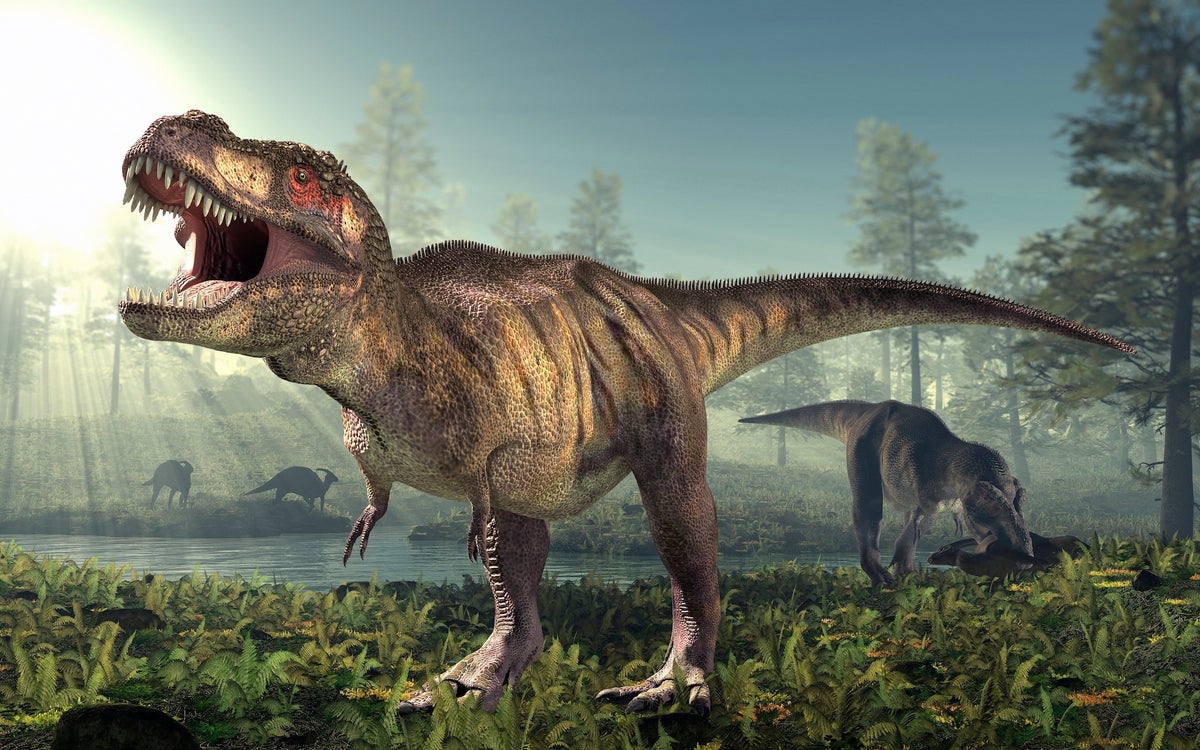
T. rex Never Stopped Growing, Dinosaur Bone Study Suggests
Deep in the leaf litter, beneath the gnarled roots of an ancient oak, a trap-jaw ant snaps its mandibles shut with a speed that defies belief. In less than a millisecond, its jaws accelerate at over 100,000 times the force of gravity, a blur of biological engineering designed for hunting and defense. This incredible feat, often unseen, often unheard, is just one whisper from a world teeming with life that operates on scales and timelines far removed from our own. It’s a world where every rustle, every glint of chitin, hints at complexities we are only just beginning to truly grasp. Just as paleontologists continue to unearth astonishing new details about creatures like Tyrannosaurus rex, revealing that even our most iconic giants held secrets of continuous growth and longevity we hadn’t imagined, so too does the microscopic realm of insects and arachnids perpetually surprise us, proving that the more we look, the more we find hidden dimensions of existence and ongoing evolution.
The notion that we’re constantly revising our understanding, even of something as seemingly monolithic as a dinosaur’s life cycle, resonates deeply within entomology. For centuries, humanity observed insects and arachnids primarily through the lens of agriculture or nuisance. But look closer, slow down, and you begin to see patterns, behaviors, and adaptations that rewrite every assumption. Take the aforementioned trap-jaw ant (genus Odontomachus), whose lightning-fast strike isn’t merely a parlor trick. It’s a sophisticated evolutionary response, allowing them to stun prey, launch themselves to escape predators, or even clear obstacles. Recent studies, leveraging high-speed cameras and micro-CT scans, have revealed the intricate muscular and skeletal mechanics behind this power, showing how stored elastic energy is released with breathtaking efficiency. It’s a system that has been honed over millions of years, a continuous refinement, much like the subtle, ongoing physiological changes now being discovered within the bone structure of long-extinct giants. Or consider the humble caddisfly larva, building intricate cases of pebbles and silk, each design unique to its species, a miniature architect in a flowing stream. Each discovery peels back another layer, revealing lives far richer and more dynamic than we ever conceived.
This persistent unfolding of new information, the revelation that life, at every scale, is far more dynamic than we initially perceive, is a guiding principle in my work. Consider the astounding longevity of some arachnids. While many insects complete their life cycles in weeks or months, a female tarantula can live for 20-30 years, molting annually, slowly growing, and becoming a cornerstone of her localized ecosystem. Imagine a creature that has witnessed decades of seasons, silently impacting its patch of earth. Or consider the social insects: a queen termite might reign for decades, her colony an organism unto itself, expanding and adapting through generations of workers, a continuous, evolving superorganism. Even the seemingly ephemeral periodical cicadas spend 13 or 17 years underground as nymphs, their hidden growth a slow, patient accumulation of energy before their spectacular, brief emergence. These creatures are not static; they are continuously interacting, adapting, and influencing their environments in ways that extend far beyond a single season. We’re constantly discovering new aspects of their communication, their symbiotic relationships, and their impact on nutrient cycling, challenging our previous, often simplistic, notions of their “fixed” roles. Every new observation, every piece of data, adds another layer to their story, much like finding growth rings in a dinosaur bone that hint at a longer, more complex life than previously theorized.
The ecological context of these hidden lives is where their true significance shines. These are not merely isolated curiosities; they are the gears, springs, and vital lubricants of nearly every terrestrial ecosystem. Think of the unsung heroes of decomposition: carrion beetles, whose meticulous burial of small carcasses prevents the spread of disease and recycles nutrients, or the myriad species of soil mites and springtails, invisible to the casual glance, yet responsible for breaking down organic matter, aerating soil, and facilitating plant growth. Their collective “growing” impact, their ceaseless activity, underpins the health and resilience of forests, grasslands, and even urban parks. Beyond decomposition, consider the vast army of pollinators – bees, butterflies, moths, beetles, and flies – without whom a third of our food crops and countless wild plants would simply cease to exist. Predators like dragonflies and assassin bugs keep other insect populations in check, maintaining a delicate balance. Even ants, often overlooked, play critical roles in seed dispersal, soil aeration, and nutrient redistribution. Their continuous, often unseen, influence is a powerful counterpoint to the more dramatic, but equally vital, roles of larger fauna. They demonstrate that the world is sustained not just by its visible giants, but by an intricate, interwoven network of countless small, persistent lives.
For the ‘Wandering Science’ traveler, the good news is that this hidden world is accessible everywhere. You don’t need to book a safari to witness extraordinary life; you simply need to change your perspective and slow down. Start in your own backyard or a local park. Turn over a log, gently sift through leaf litter, or examine the underside of a rock. You might encounter a millipede meticulously cleaning itself, a beetle scuttling with purpose, or a spider patiently waiting in its web. A magnifying glass is your portal to a new dimension, revealing intricate patterns on a beetle’s wing or the delicate hairs on a spider’s leg. Visit a national park or nature reserve, and seek out guided insect walks or interpretive centers that highlight local invertebrate populations. The key is observation and patience. Spend five minutes absolutely still, focusing on a patch of ground a foot square. You will be astonished at the amount of activity – a veritable city of minute beings carrying out their daily routines. Consider investing in a field guide specific to your region’s insects and arachnids; learning their names and behaviors transforms them from anonymous “bugs” into fascinating individuals with compelling stories. Remember, every creature, no matter its size, possesses a unique biology and plays a critical role. By observing them, we gain a deeper appreciation for the planet’s biodiversity and the continuous, dynamic processes that shape life itself. Just as the study of a T. rex bone can reveal a lifetime of growth and change, a moment spent observing an ant can open a window into an entire universe of complexity and ongoing evolution.
This journey into the micro-cosmos is not just about identifying species; it’s about understanding connection, resilience, and the sheer ingenuity of life. It’s about recognizing that growth, adaptation, and impact are not exclusive to the charismatic megafauna, but are fundamental principles woven into the very fabric of existence, from the largest dinosaur that ever walked to the smallest mite navigating a grain of soil. It’s a reminder that even when we think we know a subject thoroughly, there are always more layers to uncover, more hidden stories to tell, and more wonders waiting to be discovered. So next time you’re out exploring, take a moment to look down, to peer into the shadows, and to listen to the silent hum of the unseen. You might just find that the world you thought you knew is far more alive, and far more wondrous, than you ever imagined, continuously growing and evolving in ways we are only beginning to comprehend.

About admin
A curious explorer documenting the intersection of science and travel. Join the journey to discover the hidden stories of our planet.
Leave a Reply