
Beetles steal the scent of ants to secretly live among them
Beneath the dappled canopy of a temperate forest, or perhaps along the sun-baked path of a tropical savanna, a silent, ceaseless drama unfolds. It is a world governed by scent, a complex tapestry of chemical signals that dictate who belongs and who is an intruder. For the millions of ants bustling through their subterranean cities and surface highways, these invisible olfactory cues are as vital as sight, defining the very fabric of their communal existence. Yet, within this meticulously organized society, a secret agent operates, a master of disguise so complete that it lives out its entire life cycle as an undetected guest, a phantom within the bustling throng. This is not a tale of brute force or stealthy evasion, but of an infinitely more subtle form of infiltration: the theft of identity, molecule by molecule.
Imagine, if you will, the scent of home. For an ant, this isn’t a nostalgic memory but a precise chemical signature, a unique blend of hydrocarbons coating its exoskeleton. This cuticular hydrocarbon (CHC) profile acts as a passport, a family crest that proclaims, “I am one of you.” Researchers have long marveled at the seemingly impenetrable nature of ant colonies, their fierce protection of their kin, and their ruthless expulsion of outsiders. How, then, could another species not just enter, but thrive, within such a fortress of chemical recognition? The answer lies in a remarkable evolutionary coup performed by certain species of rove beetles, particularly those from the genus *Lomechusa* and *Atemeles*, which have perfected the art of chemical mimicry to an astonishing degree. They don’t just mask their own scent; they actively acquire and display the scent of their ant hosts.
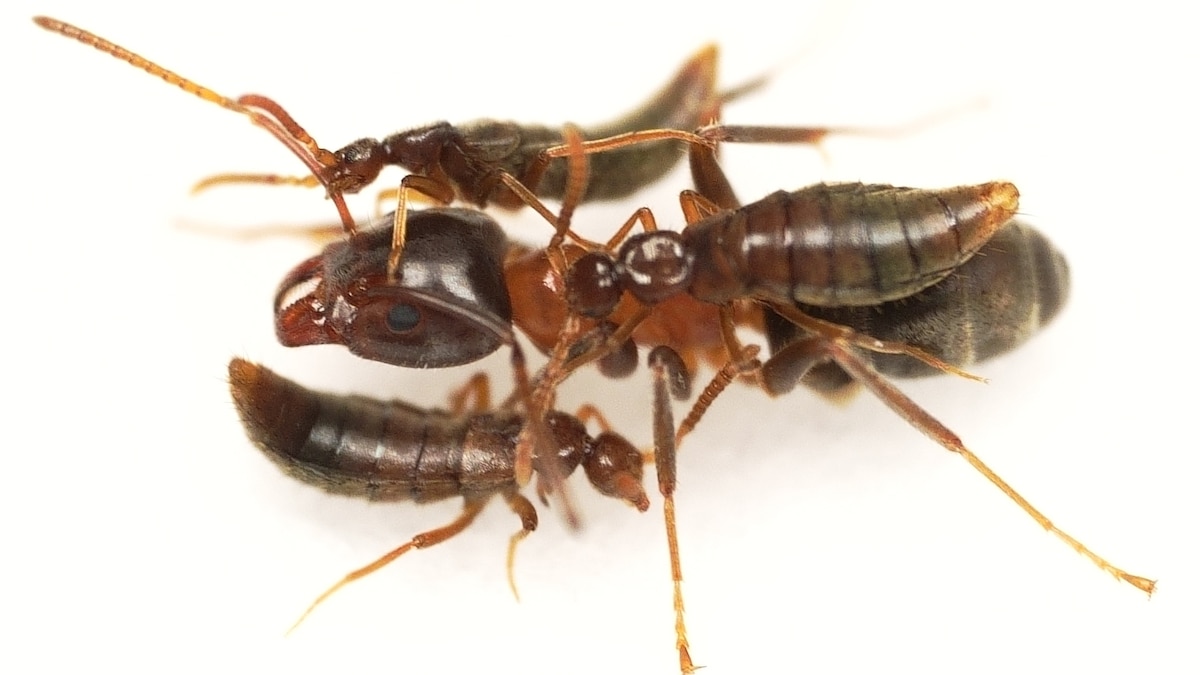
The process begins not with a grand invasion, but a calculated, almost surgical, acquisition. Young rove beetles, upon encountering an ant colony, engage in a behavior known as “allomimesis.” They meticulously rub their bodies against the ants, particularly against the gaster (abdomen), where CHCs are often concentrated. Through this direct physical contact, the beetles literally “steal” the chemical signature of their hosts, absorbing these complex hydrocarbons onto their own cuticles. This isn’t a fleeting disguise; it’s a fundamental re-sculpting of their chemical identity. The beetles then further refine this mimicry by producing their own host-specific CHCs, often synthesizing compounds that precisely match those of the ant colony they wish to infiltrate. This dual strategy – acquisition and synthesis – creates a chemical cloak so perfect that the ants, relying solely on their olfactory senses, perceive the beetle as one of their own. They are accepted, fed, and even cared for, often at significant cost to the ant colony. What makes this infiltration particularly profound, and perhaps a touch tragic for the beetle, is the irreversible nature of this commitment. Once a beetle has chemically committed to a specific ant colony, adopting its unique scent, it can never leave. To venture into another colony would be to carry the wrong passport, a death sentence from the fiercely xenophobic ants. Their entire life, from larva to adult, is tethered to the fate of their unwitting hosts.
This sophisticated deception is more than a mere curiosity; it offers a profound window into the intricate arms race of co-evolution and the hidden language of chemical communication that underpins so much of the natural world. Ant colonies, with their advanced social structures and complex division of labor, represent a highly valuable, resource-rich environment. For a parasite or commensal to gain entry, it must overcome formidable defenses. The rove beetles’ strategy highlights the paramount importance of chemical cues in social insect societies. Beyond the ants and beetles, similar battles of recognition and deception play out across countless ecosystems. Cuckoo birds lay their eggs in the nests of other species, mimicking the host’s eggs in appearance and later, the chicks’ calls for food. Orchids mimic the scent and appearance of female insects to trick males into pollinating them. These examples, from the macroscopic to the microscopic, illustrate a fundamental principle: evolution often favors the subtle manipulator, the one who can exploit the established rules of engagement without resorting to direct confrontation. The rove beetle’s strategy is particularly potent because it subverts the very system of trust and kinship that allows ant colonies to function. By becoming chemically indistinguishable, the beetle exploits the ants’ altruism and social instincts, turning their communal strength into a vulnerability. It forces us to reconsider the very definition of “identity” in the biological realm – is it genetic, morphological, or, as these beetles demonstrate, can it be purely chemical?
For the curious wanderer, the non-scientist eager to witness the marvels of the natural world, directly observing a rove beetle’s chemical infiltration is, admittedly, a challenge best left to specialized researchers with microscopes and gas chromatographs. These tiny dramas play out on a scale invisible to the naked eye. However, the broader context of ant life, the very stage upon which this chemical masquerade unfolds, is accessible to almost anyone. To truly appreciate the ingenuity of the beetles, one must first appreciate the complexity of the ants themselves. Spend an hour observing an ant colony in your backyard, a local park, or even a terrarium ant farm. Watch the meticulous trails, the hurried exchanges, the seemingly purposeful movements of each individual. Notice how they interact, how they carry food, how they defend their territory against other ant species. Look for the tiny openings to their underground cities, the mounds of excavated soil, the ceaseless activity around their entrances. While you won’t see the tiny beetles rubbing shoulders with their hosts, you will gain an appreciation for the sheer logistical feat of an ant colony, the invisible bonds that hold it together, and the incredible chemical language that governs every interaction. Knowing that within this bustling, organized society, secret agents are living their entire lives undetected, fed and protected by their unwitting hosts, adds an entirely new layer of wonder to the mundane act of watching ants. It transforms a simple observation into an appreciation for the hidden depths of nature’s deceptions, reminding us that even in the most familiar settings, the most extraordinary stories are constantly unfolding, just beneath the surface, or perhaps, just beyond the reach of our human senses.

About admin
A curious explorer documenting the intersection of science and travel. Join the journey to discover the hidden stories of our planet.
Leave a Reply