
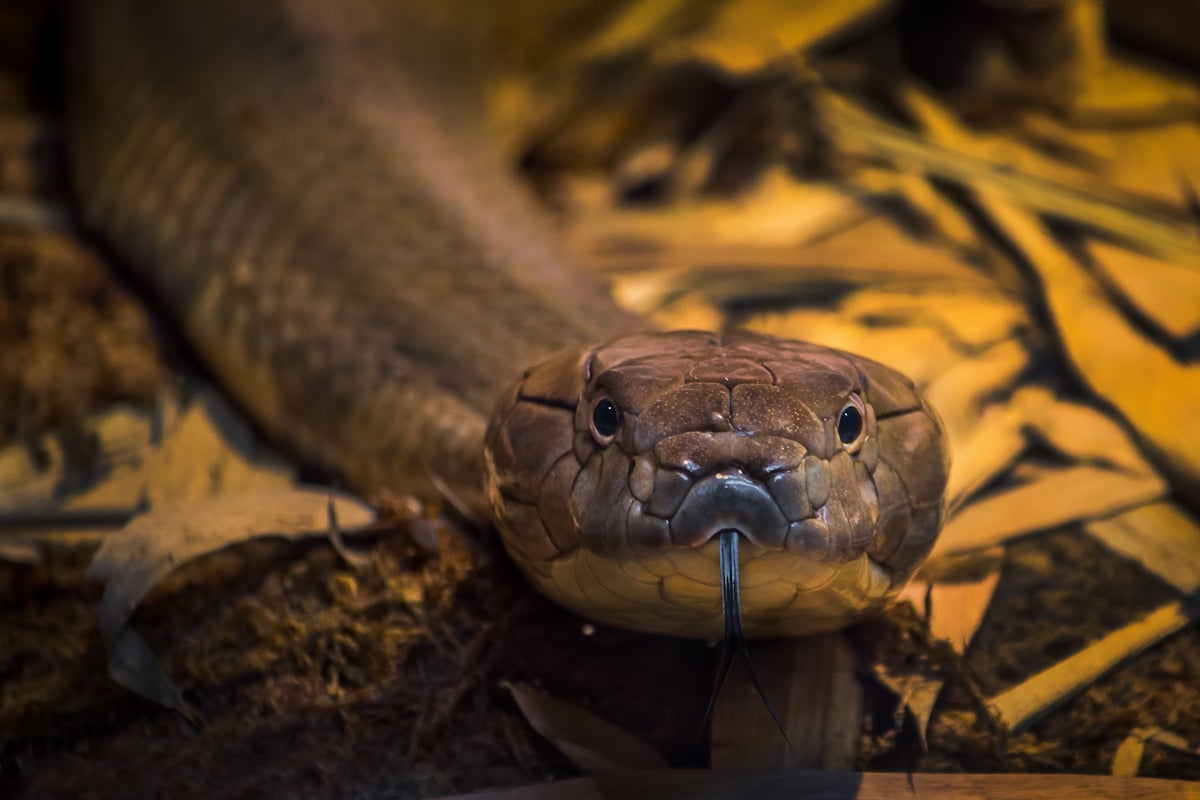
Snakes on a train? King cobras may be riding the rails in India
Yes, king cobras. A thrilling headline, isn’t it? The sheer drama of such a creature, slithering unseen through the steel arteries of a nation, immediately captures the imagination. It speaks to the wildness that persists even in our most engineered landscapes, the unexpected encounters that remind us of nature’s relentless presence. But as the Resident Entomologist for ‘Wandering Science,’ my mind inevitably drifts from the magnificent behemoths to the infinitely more numerous, and often equally dramatic, passengers that ride not just trains, but every breeze, every current, every unsuspecting traveler. While the world fixates on the possibility of a two-meter serpent stowing away in a cargo hold, I find myself captivated by the untold millions of journeys undertaken by creatures so small they could fit comfortably within a single scale of that very cobra. Deep in the leaf litter, beneath the rhythmic thrum of distant trains, a different kind of journey unfolds. A minute beetle, perhaps a species of Staphylinidae, its elytra gleaming like polished obsidian, navigates a forest of fallen oak leaves. Its antennae twitch, sampling the humid air, each delicate filament a sensor array detecting fungal spores, the pheromones of rivals, the scent of a potential mate. This small wanderer, though unseen by human eyes, is part of an intricate network of movement that defines life on Earth.
It’s easy to be drawn to the charismatic megafauna, to marvel at the migrations of wildebeest or the globe-spanning flights of albatrosses. But the true unsung heroes of dispersal, the ubiquitous voyagers who truly shape our planet’s biodiversity, are often no larger than a grain of sand. Imagine the epic, multi-generational migrations of monarch butterflies, not just across continents, but across entire lifecycles, each generation picking up the baton of travel from the last. Or consider the almost imperceptible flight of a ballooning spiderling, catching a strand of silk on the wind, lifted hundreds, sometimes thousands of feet into the atmosphere, carried for miles before gently descending to a new, uncharted territory. Their entire existence is a masterclass in opportunistic travel, a constant exploration of new frontiers. These are not merely passive displacements; they are active, finely tuned strategies honed over millennia of evolution. From the springtails ‘catapulting’ themselves away from predators with a specialized appendage called a furcula, to the intricate aerial ballets of aphids, whose winged forms emerge precisely when populations become too dense, prompting them to seek new pastures, the insect world is a masterclass in mobility. They remind us that ‘travel’ isn’t just about covering distance; it’s about survival, about genetic exchange, and about seeding life in every conceivable nook and cranny of our world.
A recent fascinating discovery, for instance, has illuminated the incredible dispersal strategies of certain springtail species, Collembola, often overlooked inhabitants of the soil and leaf litter. Researchers, employing novel isotopic tracking methods, have begun to unravel how these minute arthropods, typically thought to be quite sedentary, are in fact utilizing atmospheric currents and even the fur of small mammals to achieve surprisingly broad distribution. One groundbreaking study, published in a highly impactful ecological journal, meticulously traced the isotopic signatures of springtails found in geographically disparate forest fragments across a fragmented landscape. The findings suggested a far more interconnected metapopulation structure than previously assumed, indicating that these ‘ground-dwellers’ are, in fact, frequent aerial voyagers, caught up in updrafts and carried for miles, or even hitching a ride on the static-charged hairs of a passing mouse. It’s a subtle form of ‘rail travel,’ where the rails are invisible air currents or the unsuspecting bodies of other creatures. This redefines our understanding of their ecological reach and genetic exchange, proving that the concept of ‘travel’ for the very small is far more pervasive and complex than simply observing a large animal move. The data, meticulously collected over several seasons, painted a picture of constant, low-level dispersal, a slow but steady genetic mixing that counteracts the isolating effects of habitat fragmentation. It’s a powerful reminder that even the most seemingly insignificant creatures possess sophisticated adaptations for navigating their world, influencing biodiversity on scales we are only just beginning to fully comprehend. The implications for conservation are profound, suggesting that protecting small, isolated patches of habitat might still allow for genetic exchange if the dispersal mechanisms of these micro-travelers are understood and maintained.
These hidden journeys, whether by phoretic mites, airborne springtails, or the countless other invertebrates employing similar strategies, are not mere curiosities; they are foundational pillars of ecosystem health. Imagine the profound implications for nutrient cycling: a beetle carrying fungal spores on its legs, dispersing them to a new patch of decaying wood, initiating a crucial decomposition process that breaks down organic matter and returns vital nutrients to the soil. Or the microscopic protozoa, transported inadvertently in the gut of an insect, then deposited elsewhere, seeding new microbial communities essential for soil fertility and plant growth. The seemingly random movements of these small creatures are, in aggregate, orchestrating a silent, continuous reshuffling of genetic material, microbial life, and nutrient resources across entire landscapes. Without these ‘unseen commuters,’ many ecosystems would lose their resilience, their ability to adapt to environmental change, and their very capacity for renewal. They are the unsung architects of biodiversity, the quiet engines driving ecological processes that support all larger life forms, including the crops we eat and the forests we cherish. Their movements, though often invisible to the naked eye, are threads in the intricate web of life, connecting distant habitats and ensuring the health and dynamism of the planet.
So, if the thought of a king cobra on a train sparks your imagination, I urge you to look closer, much closer, at the world beneath your feet and around you. You don’t need a ticket to India to witness incredible journeys. Grab a simple magnifying glass, a headlamp, and perhaps a small white sheet. Venture into your local park, your garden, or even the neglected corner of your balcony. Shine a light on the leaf litter after a rain shower, and you might spot a springtail leaping with surprising agility, a tiny acrobat navigating its miniature jungle. Observe a common housefly resting on a windowpane; with a strong enough magnifier, you might discern the minute hitchhikers clinging to its legs – perhaps mites, or even smaller insects, embarking on their own unwitting voyages. Look at the underside of a fallen log, and you could discover beetle larvae, each a miniature excavator, tunneling through decaying wood, transforming the forest floor. Set up a light trap at night – a simple white sheet illuminated by a bright bulb – and watch as a bewildering array of moths, beetles, and other nocturnal travelers arrive, many having journeyed from surprising distances on the night’s currents. The key is patience and a profound shift in perspective. To truly appreciate the ‘trains’ and ‘passengers’ of the insect world, one must slow down, shrink their focus, and open their mind to the extraordinary drama unfolding on a scale we too often ignore. Every patch of soil, every blade of grass, every gust of wind is a highway for untold millions of lives, each with its own story of dispersal, survival, and impact. The world of insects and arachnids is not just small; it is vast in its complexity, profound in its influence, and endlessly fascinating for those willing to look.

About admin
A curious explorer documenting the intersection of science and travel. Join the journey to discover the hidden stories of our planet.
Leave a Reply