
Spatial barcoding reveals reaction radii and contact-dependent mechanism of proximity labeling
Deep in the silent, shadowed world beneath a fallen log, a drama unfolds with microscopic precision. A minute beetle, no larger than a grain of rice, navigates a labyrinth of decaying wood fibers. It’s not just wandering; it’s following an invisible trail, a chemical whisper left by a potential mate. Its antennae, exquisite sensory instruments, are scanning, processing, detecting. This tiny creature operates within a meticulously defined “reaction radius,” a sphere of influence where specific signals trigger specific behaviors. Too far, and the pheromone scent dissipates into the humid air, becoming undetectable. Too close, and the beetle might startle the very object of its search. This isn’t just a random walk; it’s a finely tuned dance of proximity, a contact-dependent mechanism guiding its very existence.
As an entomologist, my passion lies in pulling back the curtain on these hidden worlds, revealing the astonishing complexity that thrives just beyond our casual notice. We often stomp through landscapes, oblivious to the intricate networks of life unfolding at our feet, above our heads, and within the very structures we inhabit. But once you start looking, truly looking, you begin to see patterns, signals, and responses that define entire ecosystems. Every ant marching in formation, every spider spinning its web, every bee visiting a flower – each is a data point in a vast, living experiment, demonstrating how life, even at its smallest scales, is governed by precise rules of interaction and proximity. It’s a constant, silent symphony of communication, where distance and contact are critical variables.
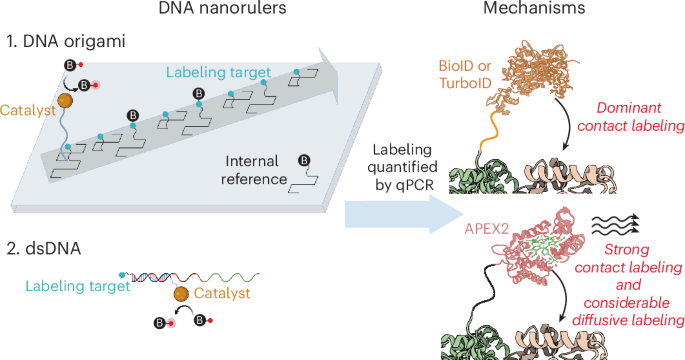
Consider the orb-weaving spider, a master architect of the insect world. Its web isn’t just a trap; it’s an extension of its sensory system, a highly effective “spatial barcoding” device. Each strand, meticulously placed, transmits vibrations with incredible fidelity. When a fly blunders into the silken snare, the spider doesn’t rely on sight alone. Instead, it interprets the specific frequency and amplitude of the vibrations rippling through the web. This is its “proximity labeling” in action. The web itself defines the spider’s “reaction radius”—the area within which it can detect and respond to prey. The “contact-dependent mechanism” is the physical impact of the prey on the silk, instantly signaling a meal or a threat. What’s truly remarkable is the specificity: a struggling grasshopper creates a different vibrational signature than a gentle breeze, allowing the spider to differentiate and react appropriately. Researchers have even studied these vibrations, effectively “barcoding” the different signals to understand the spider’s decision-making process.
Then there are the chemical conversations. Ants, for instance, are the undisputed champions of chemical communication. Their trails are elaborate “spatial barcodes” laid down with pheromones, guiding entire colonies to food sources, warning of danger, or marking territory. Each chemical compound acts as a unique label, and the concentration gradient defines the “reaction radius” for following ants. A scout ant discovers a food source and returns, laying a trail. The stronger the trail, the more ants are recruited, creating a positive feedback loop. This is a classic “contact-dependent mechanism,” where direct interaction with the pheromone molecules on the substrate dictates behavior. Disrupt this trail, and the intricate social structure can falter. Imagine trying to understand a bustling city by only observing its buildings; without understanding the traffic flow, the communication networks, and the individual interactions, you miss the essence of its function. For insects, these chemical trails are their highways, their internet, their very language.
The precision extends to reproduction. Fireflies, those enchanting beacons of summer nights, engage in a dazzling display of “proximity labeling.” Each species possesses a unique flash pattern—a specific sequence of blinks and pauses—that acts as a “spatial barcode” for identification. A male firefly flashes, and a female of the same species responds with her own specific pattern, but only if he is within her “reaction radius,” a distance where his light signal is clearly discernible and interpretable. This “contact-dependent mechanism” isn’t about physical touch, but about a light signal crossing a specific distance to trigger a precise biological response. Misinterpretations are costly, leading to wasted energy or even predation by “femme fatale” fireflies of other species that mimic the flash patterns of potential mates to lure unsuspecting males to their doom. This highlights the incredible evolutionary pressure for accurate signaling and interpretation within these defined radii.
Understanding these “reaction radii” and “contact-dependent mechanisms” isn’t just an academic exercise; it’s fundamental to comprehending the ecological fabric of our planet. Every insect, every arachnid, is connected in a complex web of interactions. A parasitic wasp, for instance, might locate its host by detecting specific chemical cues released by the host insect, or even by the plants damaged by the host. This “spatial barcoding” of chemical signals allows the wasp to pinpoint its target with astonishing accuracy, often over significant distances relative to its size. The “reaction radius” here is the effective range of its chemoreceptors, and the “contact-dependent mechanism” is the detection of those specific volatile organic compounds. If those chemical signals are altered by pollution, climate change, or even human intervention, the wasp’s ability to find its host is compromised, potentially leading to population imbalances.
Consider the delicate dance between pollinators and flowers. A bee’s “reaction radius” to a flower is determined by its ability to detect visual cues (color, pattern), olfactory cues (nectar scent), and even electrical fields. The “contact-dependent mechanism” is the physical act of landing on the flower, triggering pollen transfer and nectar collection. The “spatial barcode” is the flower’s unique combination of these signals, advertising its rewards. When these signals are disrupted, perhaps by pesticide application that masks scents or alters visual cues, the entire pollination system can break down, with far-reaching consequences for agriculture and biodiversity. These examples underscore that even the most seemingly insignificant interactions are integral to the larger ecological picture, forming a robust yet fragile system of checks and balances.
So, where can a curious traveler, a ‘Wandering Scientist’ enthusiast, go to witness these incredible phenomena firsthand? The answer, delightfully, is almost anywhere. You don’t need a passport to a remote jungle (though those are certainly spectacular). You can start in your own backyard, a local park, or a nearby patch of woods. The key is to shift your perspective. Instead of looking out, look down. Instead of looking generally, zoom in.
Grab a magnifying glass and spend an hour observing a single patch of leaf litter. Watch ants. Are they following an invisible line? Do they react differently to a crumb of food versus a dead insect? This is their “spatial barcoding” in action. Observe a spider web at dawn, shimmering with dew. Gently pluck a tiny blade of grass and touch it to a non-sticky part of the web. Watch the spider’s reaction. It’s interpreting those vibrations within its “reaction radius.” At dusk, if you’re in an area with fireflies, simply sit quietly and observe their light show. Can you distinguish different flash patterns? Are some more dominant in certain areas? You’re witnessing their “proximity labeling” communication.
For a slightly more adventurous experience, visit a botanical garden or a nature preserve. These managed ecosystems often provide excellent opportunities for observation. Look for signs of insect activity on plants: chewed leaves, galls, or the tell-tale presence of aphids and their attendant ants. Each of these tells a story of “contact-dependent mechanisms” and “reaction radii” at play. If you’re truly ambitious, a tropical rainforest offers an unparalleled spectacle of biodiversity, where every square inch teems with life and intricate interactions.
The most important tools you can bring are patience and a keen eye. Move slowly, quietly. Let the insects and arachnids go about their business, and you will be amazed by what you discover. Their world is not just a jumble of random movements; it’s a meticulously organized network of signals, responses, and precise interactions. Each tiny creature is a living barcode, constantly labeling its environment, reacting to proximity, and contributing to the grand, hidden symphony of life. Once you start to see it, you’ll find yourself caring deeply about the small wonders that uphold our world, realizing that their intricate lives are far more profound than we ever imagined.

About admin
A curious explorer documenting the intersection of science and travel. Join the journey to discover the hidden stories of our planet.
Leave a Reply