
Sleep-dependent infraslow rhythms are evolutionarily conserved across reptiles and mammals
The world stills for sleep. From the quiet sigh of a human drifting into slumber to the subtle shifts of a lizard basking in the cool dawn, the cessation of conscious activity is a universal, yet profoundly mysterious, state. We spend a third of our lives immersed in it, and nearly every creature with a nervous system does the same. For centuries, sleep has been a subject of both scientific scrutiny and poetic contemplation, its fundamental purpose and evolutionary origins often debated. What essential processes unfold when the world fades and the body rests? And how deeply are these processes etched into the very blueprint of life, across the vast branches of the evolutionary tree?
Imagine a quiet room, the soft rise and fall of a sleeping chest, the gentle rhythm of breath. Now, extend that image to a sun-warmed rock where a bearded dragon rests, or a branch where a pigeon tucks its head under a wing. While outwardly different, a recent groundbreaking study by Bergel et al., published in the esteemed journal *Nature*, suggests that beneath these varied forms of repose lies a shared, ancient biological rhythm, a deep pulse connecting brain and body, echoing across millions of years of evolution. This discovery doesn’t just add a piece to the puzzle of sleep; it reshapes our understanding of its fundamental nature and its journey through time.
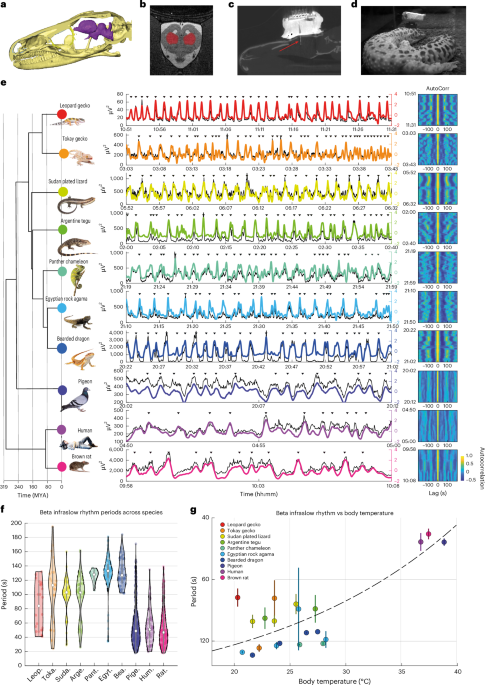
At the heart of this revelation are what scientists call “infraslow rhythms.” These are extremely slow brain oscillations, operating at frequencies less than 0.1 Hertz – far slower than the alpha, beta, or theta waves we typically associate with brain activity. Think of them as the deep, resonant hum of the brain and body working in concert during sleep, a subtle dance of neural activity synchronizing with physiological functions like heart rate, respiration, and muscle tone. For a long time, the presence and significance of these rhythms in diverse species, particularly those outside of mammals, remained largely unexplored. The Bergel team embarked on an ambitious comparative study, meticulously observing and recording brain activity in three distinct groups: mammals (mice), birds (pigeons), and reptiles (bearded dragons). Their methodology involved advanced electrophysiological recordings, allowing them to precisely detect these elusive infraslow waves during the sleep cycles of these animals. What they uncovered was remarkable: these sleep-dependent infraslow rhythms were not only present in all three groups, but they exhibited strikingly similar characteristics, suggesting a deep, shared heritage.
This finding carries profound implications for our understanding of sleep evolution. For decades, the discussion around sleep states has often centered on the distinction between REM (Rapid Eye Movement) sleep and NREM (Non-Rapid Eye Movement) sleep, and how these states are expressed differently across warm-blooded mammals and birds versus cold-blooded reptiles. While mammals and birds exhibit clear REM and NREM stages, reptiles were thought to have a more undifferentiated, “primitive” form of sleep. The presence of these conserved infraslow rhythms, however, points to a more fundamental, ancestral mechanism underlying sleep, one that predates the divergence of these major vertebrate lineages. It suggests that long before the evolution of distinct REM and NREM states, there was a foundational “proto-sleep” process involving these brain-body synchronizing rhythms, a common biological heritage shared by the last common ancestor of reptiles, birds, and mammals. This shifts the narrative from focusing solely on the *form* of sleep (REM/NREM) to its deeper, more ancient *function*.
What, then, might be the purpose of these deeply conserved infraslow rhythms? While the full scope is still being investigated, current hypotheses suggest they play a crucial role in the restorative functions of sleep. They are thought to facilitate the consolidation of memories, helping the brain process and store information acquired during wakefulness. Beyond cognition, these rhythms likely contribute to the physiological maintenance of the body, orchestrating the repair and regeneration of tissues, regulating metabolic processes, and fine-tuning the autonomic nervous system. The fact that such a fundamental process has been maintained across such diverse life forms for hundreds of millions of years underscores its essential importance for survival and well-being. It speaks to a universal need for the brain and body to enter a state of synchronized, low-frequency activity to reset, repair, and prepare for the next period of wakefulness. This shared biological imperative highlights the deep unity of life, reminding us that even in our quietest moments, we are connected to an ancient, enduring rhythm that pulses through all of existence.
For the curious wanderer of science, the implications of this study extend beyond the laboratory. While you can’t directly observe infraslow rhythms without sophisticated equipment, you can certainly witness their enduring legacy in the world around you. Begin your journey at a natural history museum, tracing the evolutionary pathways that connect us to reptiles and birds. Ponder the vast stretches of time over which these fundamental biological processes have been preserved. Then, perhaps, visit a reputable zoo or wildlife sanctuary. Spend time in the reptile house, watching the bearded dragons or iguanas as they rest, their bodies still, their eyes sometimes half-closed. Move to the aviaries, observing pigeons or other birds as they perch, occasionally shifting, but mostly in a state of quiet repose. Notice the subtle differences in their sleep postures, but allow yourself to imagine the shared, silent symphony of infraslow rhythms playing out beneath their scales and feathers, just as they do within us.
Even closer to home, observe your own pets. A dog curled on a rug, twitching its paws as it dreams; a cat stretched out in a sunbeam, its breathing deep and even. These familiar scenes are not merely moments of rest; they are living testaments to an ancient biological imperative, a deep evolutionary current that flows through all vertebrates. This new research offers a lens through which to view these everyday observations with fresh wonder, connecting the quiet slumber of a household pet to the deep evolutionary past of lizards and birds. It fosters a profound appreciation for the intricate, shared mechanisms that underpin life, inviting us to see ourselves not as isolated beings, but as participants in a grand, ongoing biological narrative, bound by rhythms that have pulsed through time for eons. The next time you find yourself drifting into sleep, consider the silent, ancient hum that connects you to the vast, diverse tapestry of life on Earth.

About admin
A curious explorer documenting the intersection of science and travel. Join the journey to discover the hidden stories of our planet.
Leave a Reply