
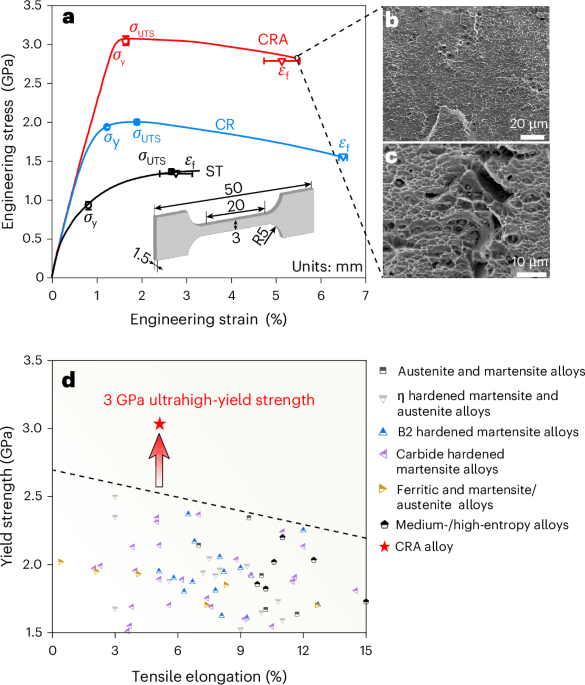
A 3-GPa ductile martensitic alloy enabled by interface complexes and dislocations
While the headline above might conjure images of advanced metallurgy and laboratories humming with high-tech equipment, the natural world, particularly the realm of arthropods, presents its own astonishing examples of strength, resilience, and intricate structural engineering. Just as scientists meticulously craft alloys with unprecedented properties, nature has spent eons perfecting the biological equivalents: exoskeletons of chitin, muscles capable of astonishing feats, and sensory systems that outperform human technology in countless ways. My role as Resident Entomologist for ‘Wandering Science’ is to pull back the curtain on this often-overlooked universe, to reveal the microscopic marvels that sustain our planet and challenge our understanding of what “strong” truly means. Forget the lab for a moment; let’s venture into the wild, where every leaf, every patch of soil, every drop of dew, hides a world of complex interactions and unbelievable biological “alloys.”
The Micro Hook: A Whispering Hunter in the Leaf Litter
Deep in the leaf litter, where sunlight struggles to penetrate and the air is thick with the scent of decay and damp earth, a drama unfolds with silent precision. Imagine a scene: a fallen oak leaf, its edges curled, forming a miniature cave. Within this shadowed sanctuary, a wolf spider, no larger than your thumbnail, waits. Its eight eyes, arranged in a distinctive pattern, are not merely for seeing; they are sophisticated light-gathering instruments, each facet a lens tuned to detect the faintest shift in shadow, the most subtle vibration. Its legs, bristly with sensory hairs, are attuned to the micro-seismic tremors of the forest floor. A springtail, a minuscule, wingless insect, hops erratically across a decaying twig a few inches away. The spider doesn’t pounce immediately. It calculates. It feels the air currents, the reverberations through the substrate. This isn’t brute force; it’s a finely tuned biological algorithm, a predatory dance refined over millions of years.
Suddenly, with a burst of speed that blurs the line between stillness and motion, the spider launches itself. The springtail, with its unique furcula (a tail-like appendage folded under its abdomen), attempts a desperate escape jump, propelled by hydrostatic pressure. But it’s too late. The spider’s fangs, tipped with venom, pierce its delicate cuticle. This isn’t just a simple hunt; it’s an intricate interplay of biomechanics, neurobiology, and evolutionary adaptation. The spider’s strength isn’t just in its muscles, but in the structural integrity of its exoskeleton – a composite material far more complex than any alloy we’ve yet devised. Its legs, for instance, are not just levers; they are hydraulic systems, capable of rapid extension and powerful grip, all while remaining incredibly lightweight and durable.
The Discovery: Unpacking Nature’s Engineering Marvels
When we talk about “strength” in the insect world, we’re not just referring to raw power, but to a suite of incredible adaptations. Consider the humble flea, an animal renowned for its prodigious jumping ability. If a human could jump proportionately as high as a flea, we’d clear skyscrapers with ease. How do they do it? It’s not just muscle. Fleas employ a biological spring mechanism, a pad of specialized elastic protein called resilin. This protein is one of nature’s most remarkable elastomers, capable of storing and releasing energy with extraordinary efficiency, far surpassing synthetic rubbers. When a flea prepares to jump, it compresses this resilin pad, slowly building up potential energy. Then, in a fraction of a second, it releases that energy, launching itself with an acceleration that would crush an unprotected human. This “interface complex” of muscle, cuticle, and resilin is a masterpiece of biological engineering, allowing for incredible performance from a minuscule organism.
And what about the structural integrity? The insect exoskeleton, primarily composed of chitin – a robust polysaccharide – interwoven with proteins, forms a lightweight yet incredibly tough armor. This isn’t a uniform material; it’s a gradient composite. The outer layer, the epicuticle, is often waxy and water-repellent. Beneath it, the exocuticle provides rigidity, while the endocuticle is more flexible. The arrangement of chitin fibers within these layers can vary, creating anisotropic properties, meaning its strength differs depending on the direction of stress. Imagine the shell of a beetle: it can withstand immense pressure relative to its size, yet remain flexible enough for flight or burrowing. This flexibility and toughness come from the precise arrangement of chitin microfibrils in a helicoidal pattern, much like plywood or carbon fiber composites, allowing for crack deflection and energy dissipation – a natural analogue to the “dense dislocation networks” that give advanced alloys their ductility and strength.
Recent studies, applying advanced microscopy and biomechanical testing, have begun to unravel the secrets of these natural structures. We’re finding that the cuticle isn’t just a simple shell; it’s a dynamic, living tissue capable of repair and adaptation. The coloration on many insects, for instance, isn’t always pigment; it’s often structural, created by nanoscopic architectures that scatter light in specific ways, much like a photonic crystal. This structural color can even change based on humidity or temperature, offering a form of biological camouflage or signaling. The precision with which these structures are laid down, atom by atom, protein by protein, rivals the most advanced additive manufacturing techniques developed by humans.
Ecological Context: The Unseen Pillars of Life
These individual feats of engineering aren’t isolated curiosities; they are the fundamental building blocks of almost every terrestrial ecosystem. Insects and arachnids form the very foundation of the food web. Without them, most birds would starve, flowering plants would fail to reproduce, and decomposition cycles would grind to a halt. Consider the humble dung beetle: it processes vast quantities of animal waste, returning nutrients to the soil and preventing the build-up of parasites. Its strength, enabling it to roll balls of dung many times its own weight, is crucial to this ecological service. Or the ant, a creature whose complex social structures and collaborative construction projects rival human cities. An ant colony, with its intricate tunnels and chambers, is a marvel of collective engineering, each individual contributing to a structure that provides shelter, food storage, and defense for thousands.
Pollinators, from bees and butterflies to flies and beetles, are indispensable. Their delicate movements, guided by sophisticated navigation systems and sensory organs, ensure the reproduction of over 75% of the world’s food crops and nearly 90% of wild flowering plants. The intricate dance between flower and pollinator, refined over millions of years of co-evolution, is a prime example of biological “interface complexes” at work, where two seemingly disparate elements interact for mutual benefit, creating a robust and resilient system. Their strength isn’t just physical; it’s the strength of their interconnectedness, their role as keystone species.
Even predators like the wolf spider we observed play a vital role in population control, keeping herbivore numbers in check and contributing to the overall health of the ecosystem. Every insect, every arachnid, no matter how small or seemingly insignificant, is a cog in the vast, intricate machinery of life. Their collective biomass outweighs that of all humans several times over, and their daily activities, from aerating soil to breaking down organic matter, are essential services that we often take for granted. Understanding their unique biological “alloys” and “networks” helps us appreciate the resilience and complexity of the natural world.
The Field Angle: Where to Witness These Wonders
You don’t need a high-tech lab or an expedition to a remote jungle to witness these biological marvels. The beauty of entomology is its accessibility. Your own backyard, a local park, or even a potted plant on your windowsill can be a vibrant ecosystem teeming with life. Here’s how you, a Wandering Science enthusiast, can begin your own exploration:
- Start Small, Go Slow: Grab a magnifying glass, or better yet, a macro lens for your smartphone. Lie down on the grass or peer closely at a flower. Move slowly and quietly. Patience is your greatest tool.
- Leaf Litter Is Gold: Gently sift through fallen leaves and decaying wood. You’ll be amazed at the diversity of springtails, mites, millipedes, and tiny beetles scurrying about. This is where many decomposers, the recyclers of the forest, live their lives.
- Look Up and Down: Don’t just look at eye level. Check under rocks, logs, and bark. Look on the undersides of leaves. Many creatures hide in plain sight or prefer specific microhabitats.
- Night Life: Many insects are nocturnal. A simple flashlight walk around your garden after dark can reveal moths, crickets, nocturnal spiders, and other fascinating creatures you might miss during the day.
- Observe Behavior: Don’t just identify; observe. Watch an ant carry a crumb, a bee visiting a flower, or a spider spinning its web. Try to understand how they do what they do. What kind of strength or precision is involved?
- Record Your Findings: Keep a journal. Sketch what you see. Note the date, time, location, and any interesting behaviors. This practice sharpens your observational skills and helps you connect with the natural world.
From the incredible strength of a dung beetle navigating its weighty prize to the precise, almost surgical strike of a wolf spider, the insect and arachnid world is a constant source of wonder. These creatures, often dismissed as “bugs,” are living examples of sophisticated engineering, resilient biological “alloys,” and complex “interface complexes” that perform functions vital to our planet’s health. So next time you’re outside, take a moment. Look closer. The hidden world is waiting, ready to reveal its astonishing strength and beauty, proving that some of the most profound lessons in engineering and ecology are found not in a laboratory, but right beneath our feet.

About admin
A curious explorer documenting the intersection of science and travel. Join the journey to discover the hidden stories of our planet.
Leave a Reply